

Trying to sell hiking boots to someone who never leaves the city is a waste of time. The same goes for advertising pet food to people who don’t own pets.
Even a great product won’t generate the sales you expect if you’re offering it to the wrong audience. Many businesses try to reach everyone by launching broad advertising campaigns, publishing generic content, and hoping someone will be interested. As a result, marketing budgets are wasted while results remain disappointing.
The goal isn’t to appeal to everyone. It’s to identify your target market, understand the people who truly need your product, and communicate with them in a way that speaks to their needs.
What is a target market?
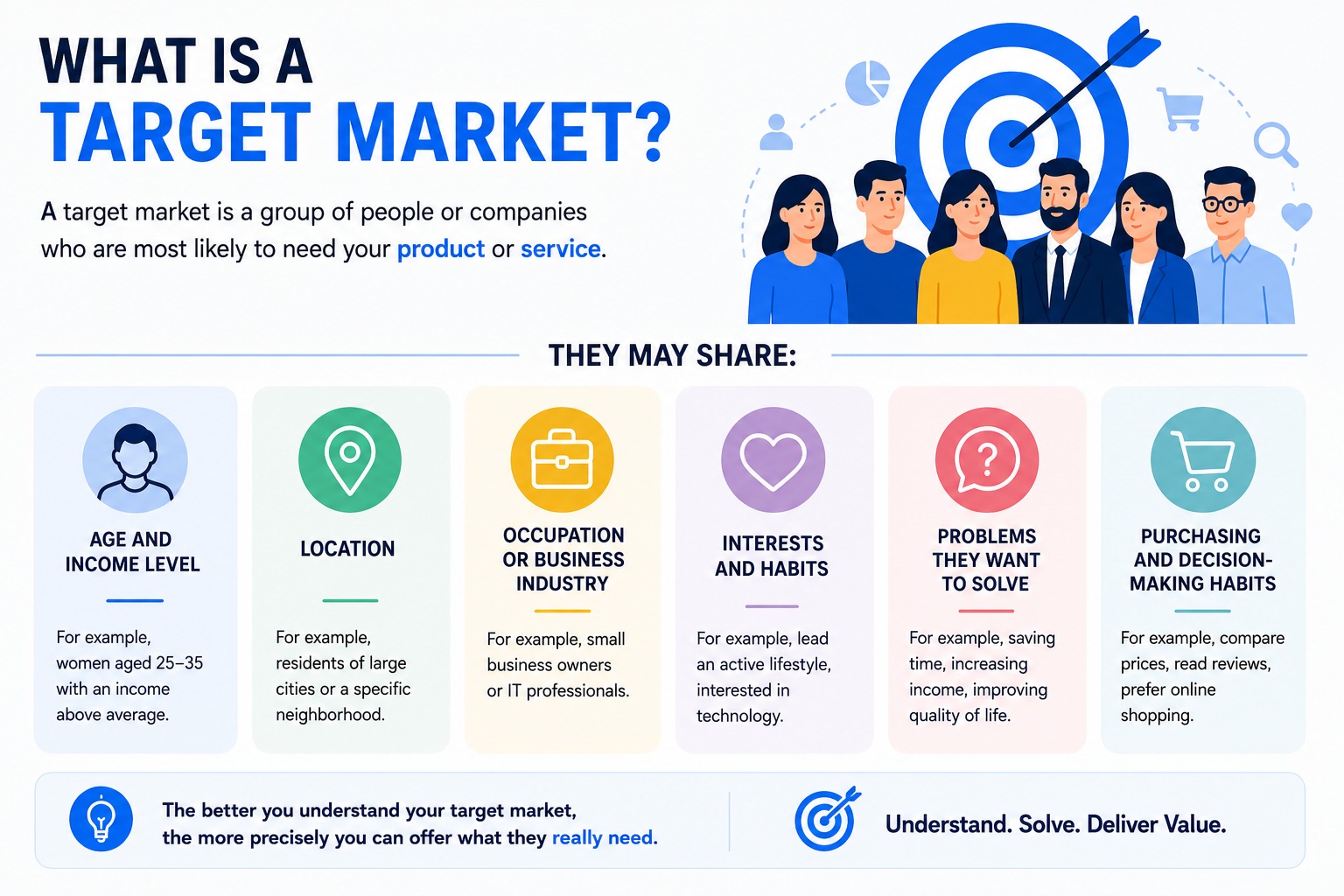
A target market is a group of people or businesses that are most likely to need your product or service.
They may share common characteristics such as:
- Age and income level.
- Location.
- Profession or industry.
- Interests and lifestyle.
- Problems they want to solve.
- Purchasing habits and decision-making behavior.
For example, an online accounting platform may not be designed for every entrepreneur. Instead, it could focus on owners of small retail stores who manage their businesses independently and want software that’s easy to learn.
The more accurately you define your audience, the easier it becomes to choose the right marketing channels, create compelling offers, and explain the value of your product.
Why understanding your customers matter
Without a clear understanding of your audience, marketing quickly turns into guesswork. Businesses experiment with different advertising channels, rewrite headlines, lower prices, yet still don’t understand why customers aren’t buying.
When you clearly understand your ideal customer, your decisions become much more precise.
You know where to find potential buyers, what challenges they face, and what prevents them from making a purchase. Instead of making vague promises like “high quality and excellent service,” you can focus on specific benefits such as saving time, reducing costs, increasing convenience, or achieving better results.
This doesn’t just help attract customers. It also improves retention because people are more likely to return to brands that understand their needs and don’t overwhelm them with irrelevant offers.
Four ways to segment your audience
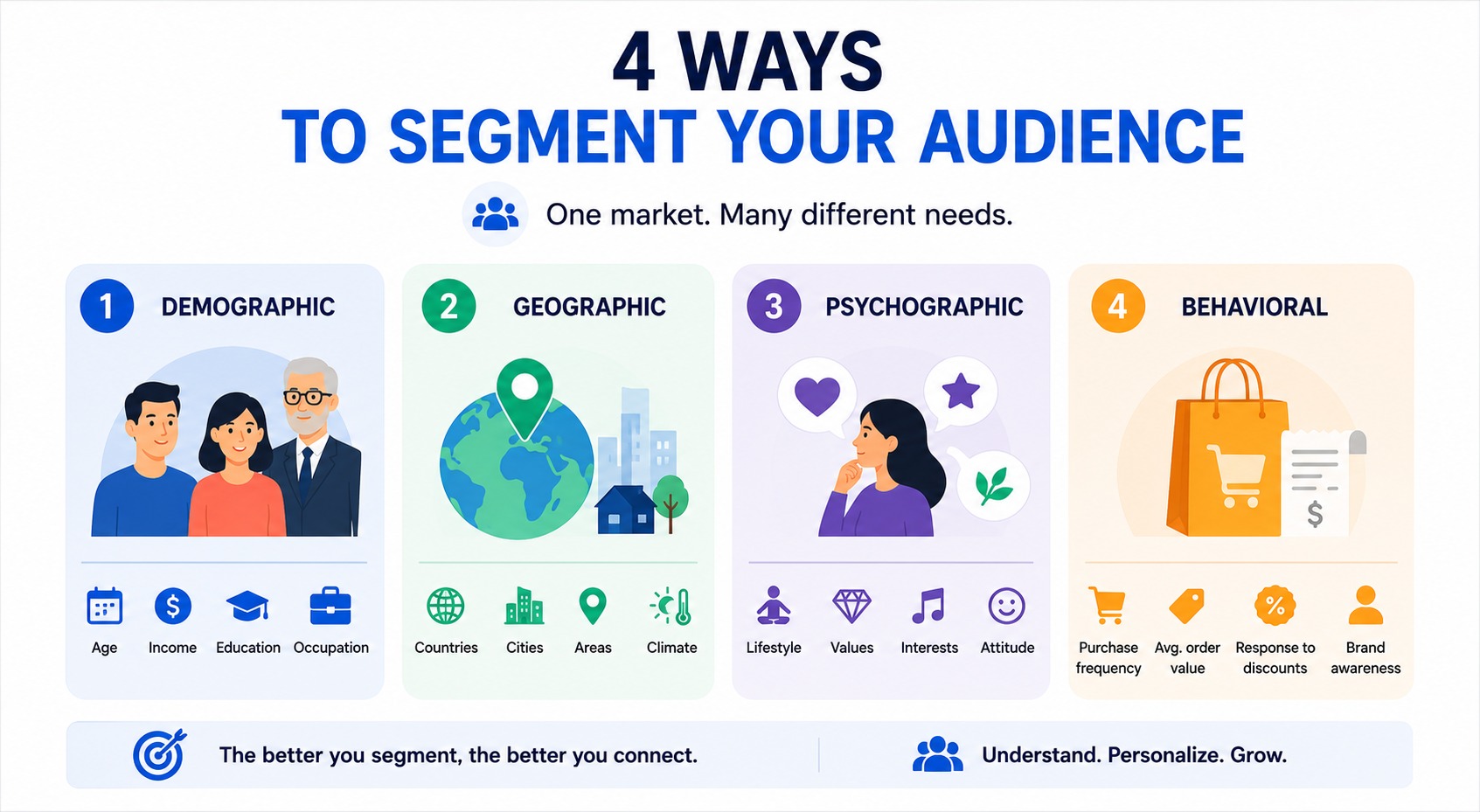
Very few markets are completely uniform. Even customers buying the same product often have different motivations. That’s why businesses divide their audience into smaller segments.
- Demographic segmentation considers factors such as age, income, education, occupation, and family status.
- Geographic segmentation groups customers by country, region, city, or climate.
- Psychographic segmentation focuses on lifestyle, values, interests, attitudes, and personality.
- Behavioral segmentation analyzes customer actions, including purchase frequency, average order value, response to discounts, product usage, and familiarity with your brand.
For example, the same skincare product can be promoted to teenagers as an acne solution and to adults as part of an anti-aging routine. The product remains the same, but the buying motivation is completely different.
How to identify your target market
Finding your audience isn’t about making assumptions. It requires analyzing reliable information from your existing customers, competitors, and market data.
Analyze your existing customers
Start with the people who already buy from you. Look at what they purchase, how often they return, how much they spend, and where they came from.
Pay special attention to your most profitable and loyal customers. What do they have in common? What problem brought them to your business? Why did they choose you instead of your competitors?
You can find these answers in your CRM system, sales history, customer support conversations, reviews, surveys, and direct interviews.
Study your competitors
Look at the audience your competitors are targeting. What customer problems do they talk about? Where do they advertise? What value do they emphasize?
The goal isn’t to copy them. Instead, look for opportunities they’ve overlooked. If everyone is targeting a broad audience, you may find success by serving a smaller group with more specific needs.
Segment your audience
Once you’ve collected enough information, organize it into clear customer segments.
Don’t group people based only on age or gender. Two people of the same age can have completely different goals, budgets, and purchasing behavior.

Instead, combine multiple characteristics to understand who they are, what they need, what challenges they face, and how they make buying decisions.
Create buyer personas
A buyer persona is a fictional profile based on real customer data.
For example:
“Anna is 34 years old and owns a small online store. She manages orders and marketing herself, so she’s looking for simple tools that save time and don’t require extensive training.”
Creating buyer personas helps you write marketing messages for real people instead of broad categories like “small business owners.”
Test and refine your strategy
Your first audience profile is rarely perfect.
Run small marketing campaigns, compare different customer segments, test different messages, and measure not only clicks but also leads, sales, and repeat purchases.
Sometimes the audience you expected to perform best shows little interest, while a smaller segment becomes your most profitable customer group.
Your target market should never be treated as something permanent. Customer needs change, new products enter the market, and buying behavior evolves. Continue analyzing your data, listening to customers, and adjusting your strategy over time.
The better you understand your audience, the less effort you’ll spend convincing them to buy. Instead, they’ll quickly recognize your product as the solution they’ve been looking for.