

A business website should communicate your product’s value, generate leads, and help customers choose services or complete purchases. That’s why, before building a business website from scratch, it’s important to define its role in your sales process and map out the visitor journey — from first impression to conversion. Without this foundation, even the most modern design is just a pretty shell that doesn’t deliver results.
Defining goals and structure
The work starts not with choosing colors, but with understanding your audience. You need to figure out:
- who is visiting your site;
- what problem they’re trying to solve;
- what doubts are holding them back from making a decision.
The answers will tell you which pages you need, what to feature above the fold, and what proof points will build trust. For most small businesses, a homepage, services page, about page, case studies, and contact page are enough. An online store will also need a catalog, product pages, a shopping cart, and a checkout. Mapping out your structure in advance helps visitors find what they need quickly.
Choosing how to build
An entrepreneur deciding how to build a business website on their own can choose between a website builder, a content management system (CMS), or custom development. Website builders let you quickly put together a simple site using pre-made blocks. A CMS offers more flexibility but requires time to configure and secure. Custom development makes sense when you need functionality that off-the-shelf solutions can’t provide.
When choosing a platform, don’t just look at the upfront cost. Consider monthly fees, the ability to migrate your site, page load speeds, ease of editing, and the quality of the mobile experience. A cheap solution can end up costing more if every new section requires a developer.
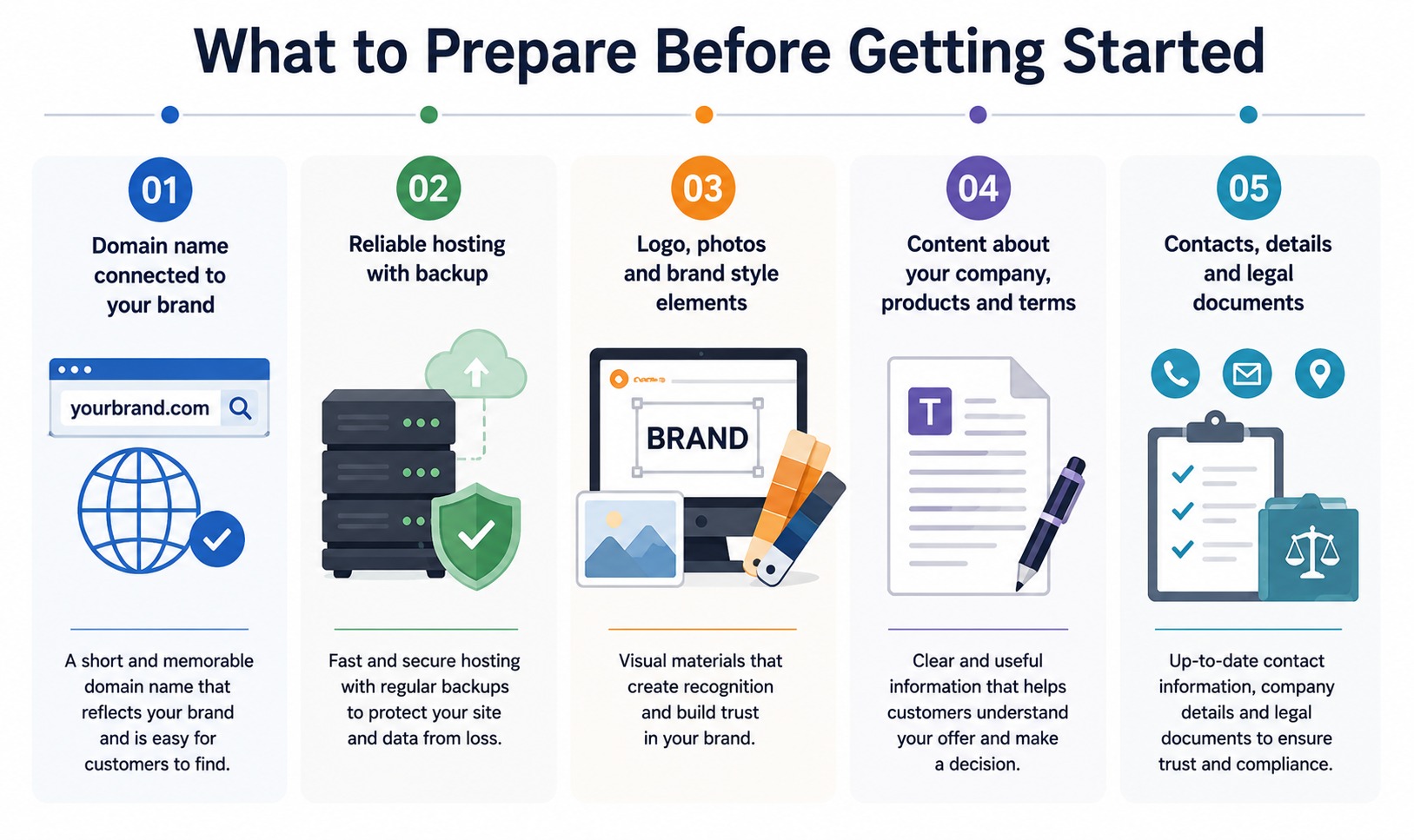
Before you start building, get the following ready:
- a domain name tied to your brand;
- reliable hosting with backup capabilities;
- a logo, photos, and brand assets;
- copy for you about page, products or services, and terms;
- contact details, business information, and legal documents.
Building and technical setup
Once you have a clear plan for building your business website, you can start putting the pages together. Begin with the core sections, then set up navigation, buttons, forms, and mobile responsiveness. Every element should guide visitors toward a clear action — a call, an inquiry, a purchase, or a booking.
Before going live, check how the site looks across different browsers, make sure all links work, test your forms, and review load times. Compress large images, remove unnecessary scripts, and secure the site with an SSL certificate. Set up analytics so you can track where your visitors are coming from and identify underperforming pages.
Preparing your content
Your copy should answer your customers’ questions, not retell your company’s history. On the homepage, clearly communicate:
- what your business does;
- who it’s for;
- why someone should choose you over the competition.

Replace vague promises with specifics: timelines, numbers, examples of your work, and warranty terms. Visuals matter too. Photos of your real team, office, production facility, or completed projects build more trust than generic stock images. If you don’t have original photos, stick to a consistent visual style and avoid cluttering your pages with unnecessary design elements.
Launch and growth
Publishing your site isn’t the finish line — it’s the starting point. After launch, review which search queries are bringing in visitors, how many of them are submitting inquiries, and where people are dropping off. Use that data to refine your copy, restructure pages, and double down on what’s resonating.
Keeping your content up to date signals that your business is active and reliable. Add new case studies, current pricing, answers to common questions, and updates about your services on a regular basis. A website becomes a truly useful business tool when it evolves based on how customers interact with it — not when it’s left untouched after launch.