

A winning concept rarely strikes like a bolt of lightning. More often, it emerges from careful observation of the market, customer pain points, and shifts in human behavior. Business idea generation methods help turn scattered thoughts into a set of hypotheses that can be tested before a project ever launches. They broaden the search field and help identify solutions with real commercial potential.
Finding problems instead of ready-made solutions
One of the most productive approaches starts with asking: what regularly frustrates people, wastes their time, or costs them more than it should? Observations can come from personal experience, customer reviews, support tickets, professional communities, and social media discussions. A recurring complaint points to a persistent need — especially when existing products only partially address it.
At this stage, it’s best not to jump straight to designing an app or service. Instead, start by clearly defining the problem and figuring out who experiences it and how often. Then assess whether the target audience is willing to pay for a more convenient solution. This protects against building a product that interests its creator but not the market.
Combining existing models
New ventures are often built not on invented categories, but on combining elements that already work. You can bring a subscription model into a new industry, add a service layer to a traditional product, simplify a complex offering, or adapt a foreign business format to local conditions. What matters most isn’t novelty — it’s the value delivered to the audience.
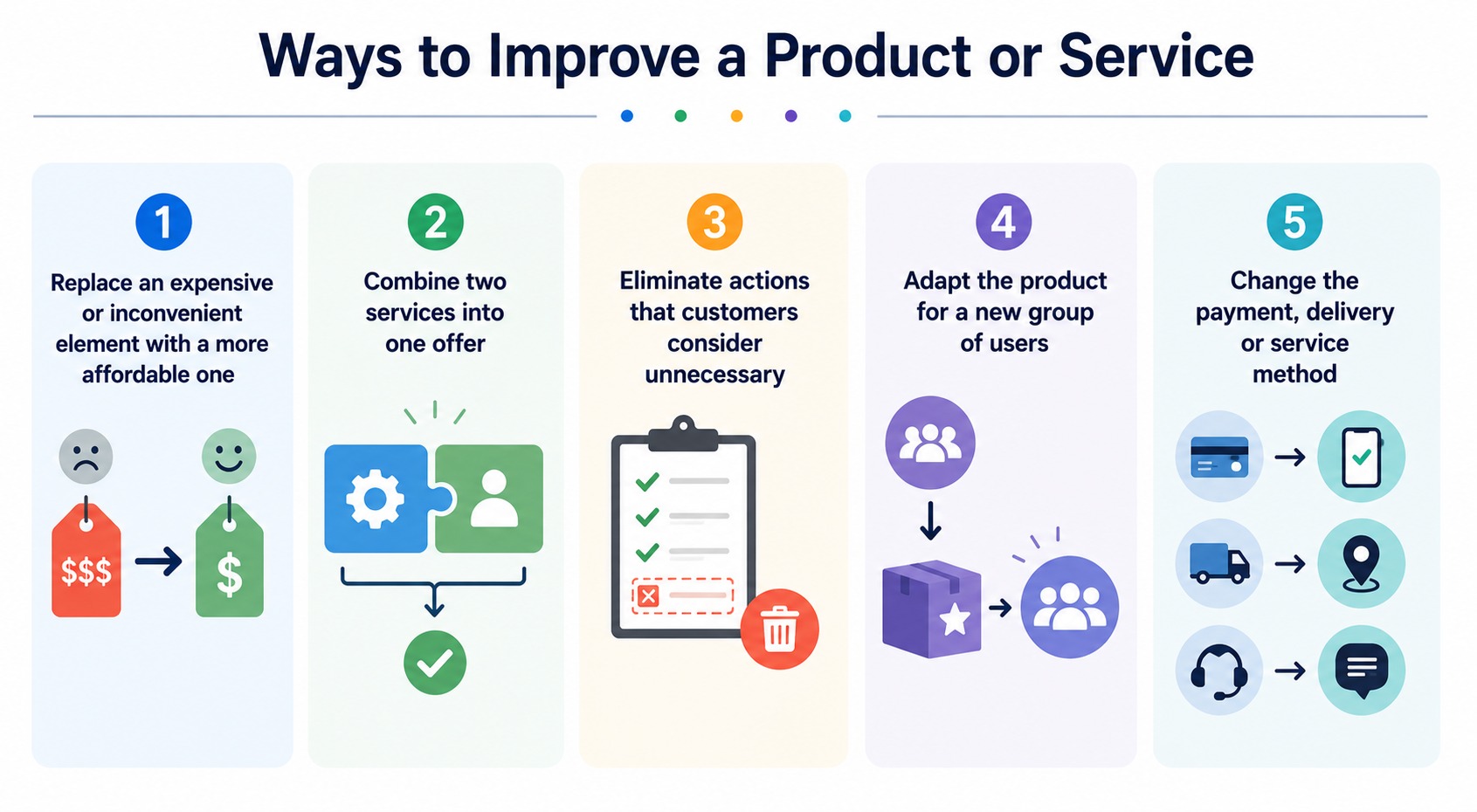
In practice, entrepreneurs use a variety of idea generation methods, including:
- Replacing an expensive or inconvenient element with a more accessible one.
- Bundling two services into a single offering.
- Eliminating steps that customers find unnecessary.
- Adapting a product for a new user group.
- Changing the payment method, delivery model, or customer service approach.
Each option should be framed as a testable hypothesis. Rather than a vague plan to “build a service for small businesses,” it’s better to hypothesize that small shop owners would pay for automated report generation. The more specific the idea, the easier it is to run interviews, build a prototype, and gauge demand.
Analyzing market shifts
Promising opportunities tend to emerge where technology, regulations, demographics, or consumer habits are changing. The rise of remote work creates demand for certain services, an aging population drives demand for others, and new reporting requirements open doors for specialized tools. The key is to look not just at the trend itself, but at the friction it creates.
It’s also worth studying adjacent industries and markets where a similar shift has already played out. If a model is already working in another country or sector, it’s worth understanding what drove its success and what it would take to replicate it elsewhere. Simple copying rarely works. You need to account for audience income levels, regulation, competition, and established purchasing habits.
Evaluating and testing ideas
A long list of options doesn’t get you any closer to launch on its own. Ideas should be compared across:
- Audience size.
- Severity of the problem.
- Accessibility of potential customers.
- Level of competition.
- Required investment.
Team capabilities also factor in. Some markets require specialized expertise, licenses, or expensive equipment to enter. The next step is rapid validation — without full-scale development. Customer interviews, test ads, a landing page, or manually delivering a service provide far more useful information than internal brainstorming. The goal isn’t to receive praise, but to see whether someone will leave their contact information, place a pre-order, or pay.
Idea generation doesn’t end with the most original concept — it ends with a viable model. A strong idea solves a real problem, makes sense to the buyer, and can be tested affordably. Moving systematically from observation to hypothesis to validation reduces the risk of pouring resources into a product nobody wants.