
How technology helps businesses improve efficiency
An employee copies data from one spreadsheet into another. A manager checks inventory by hand. A customer has been waiting three hours for an answer to a simple question.
Small delays like these cost businesses both time and money. Business process automation helps eliminate unnecessary steps, speed up daily operations, and reduce errors. However, real value comes not from installing another piece of software, but from choosing tools that solve specific business challenges.
Automation saves time
Many business activities are repetitive: preparing documents, sending notifications, updating customer records, generating reports, and monitoring inventory.
These tasks can be automated. Software can transfer data, generate invoices, send reminders, or notify staff when stock levels are running low.
Instead of spending hours on routine work, employees can focus on customer service, negotiations, product development, and other responsibilities that require human expertise.
Automation also improves accuracy. Unlike people, software does not get tired, overlook details, or forget to complete routine tasks.
Better communication and collaboration
Business processes often slow down because of poor communication rather than difficult work. A message gets lost, a file is saved in the wrong folder, or an important decision remains buried in a private conversation.
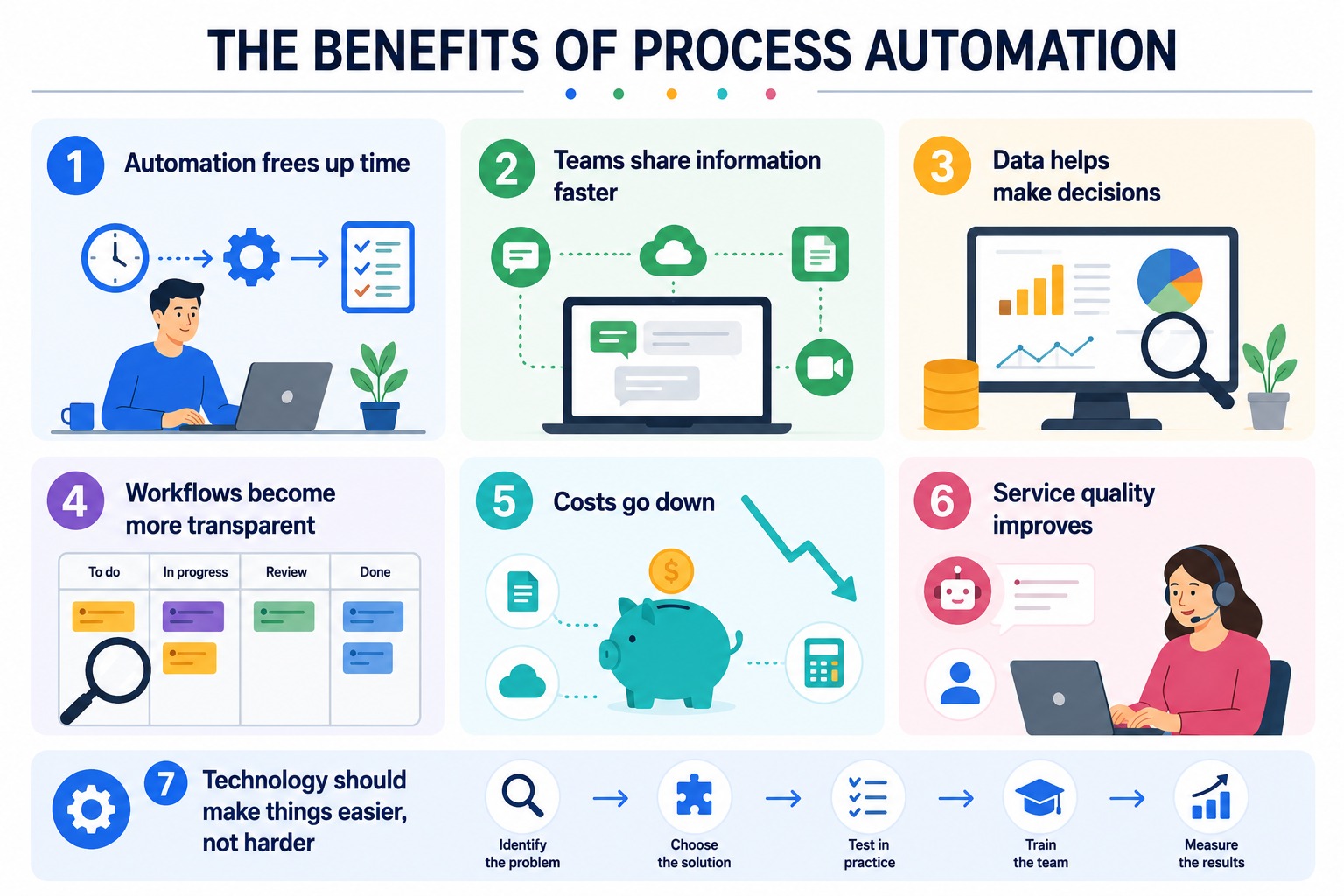
Team messaging platforms, video conferencing, shared documents, and cloud services keep everyone connected. Employees can access the latest information, discuss issues, and receive feedback without waiting for lengthy meetings.
These tools are especially valuable for remote and distributed teams, allowing people in different cities or countries to work together without disrupting workflows.
Data supports better decisions
Making decisions based on intuition alone can be expensive. Analytics tools reveal which products sell best, where customers come from, when they abandon purchases, and which expenses fail to generate results.
Managers gain a clear picture of business performance instead of dealing with disconnected numbers. This makes it easier to identify problems, test new ideas, and allocate budgets more effectively.
For example, companies can detect declining demand early, adjust inventory levels, or stop advertising campaigns that consume budget without attracting customers.
More transparent workflows
Project management platforms show who is responsible for each task, when it should be completed, and how far the work has progressed.
Instead of constantly asking, “What’s already finished?” or “Who’s handling this?”, team members can find deadlines, comments, and documents in one place.
Greater transparency reduces confusion and helps identify delays before they affect customers.
Lower operating costs
Digital documents reduce spending on paper, printing, and physical storage. Cloud computing allows businesses to use powerful IT resources without investing in expensive hardware. Online meetings also cut travel costs.

Technology makes it easier to monitor raw materials, energy consumption, working hours, and inventory, helping businesses eliminate waste and improve efficiency over time.
Better customer service
A CRM system stores customer interactions, purchases, agreements, and preferences. As a result, managers do not need to start every conversation from scratch.
Chatbots can answer common questions outside business hours while more complex requests are transferred to specialists. Customers receive faster assistance, and employees spend less time responding to repetitive inquiries.
Technology should simplify work
Simply using more software does not make a business more efficient. If employees must enter the same information into multiple systems, technology creates additional work instead of solving existing problems.
For this reason, companies should first identify where they lose the most time, money, or customers.
Once those bottlenecks are clear, they can choose the right solution, test it on a specific process, train employees, and measure the results. The best technology is almost invisible — it simply helps work get done faster, more accurately, and with fewer resources.